I received the feedback from my tutor on my first assignment today. It was very instructive. Overall the report was favourable but I have some significant areas to work on. The overall selection of images and design of the submission was positively received as were some of the images. The key area for improvement concerns creating a clear focal point in the frame. Some of my images lacked this. The image below is an example:
Hedgerow and Field, Bledlow Ridge Buckinghamshire UK
The lines in this image lead the viewer to the hedgerow at the top of the frame where in fact there is little of interest. This is clearly a key learning point for me to build on.
Based on my own views and those of my tutor, I have decided to include the images below in my Seasons Portfolio for submission at the end of the course.
Bledlow Ridge, Buckinghamshire UK
Bridge over River Thames, Sonning Berkshire UK
Sycamore, Northend Oxfordshire UK
Showing posts with label LEARNING LOG-June2010. Show all posts
2010-06-27
Light
The next part of my Photography 2: Landscape course deals with Light and its measurement. As a starting point for my work in this section I decided to do some background reading and a web search revealed a book which tackles the subject of photographic lighting from basics. The book is Light Science and Magic.
I am very pleased I did this. It is an excellent book. The section Light: the raw material of photography is particularly instructive. It begins by describing what light is from a scientific perspective. It goes on to discuss how light is described by photographers, covering the aspects of brightness, colour and contrast. Finally, it deals with the how the nature of the subject affects lighting. Light can be transmitted, absorbed or reflected by a subject. I have made a mental note to consider how elements of the landscape are responding to the light conditions and what changes to the lighting could improve the prospective image.
I remember reading a comment by landscape photographer Charlie Waite in which he stated that it is important to observe how different surfaces respond to light. Reading this book has brought this comment to life.
2010-06-14
Assignment 1: the season
I have just today sent off my first assignment on the Open College of Arts Landscape course to my tutor. I was quite please with the photographs that I included and so it will be very interesting to see what my tutor makes of them.
When compiling my observations on the images I included some comments on how I might have improved upon the images. There were two recurring themes.
First, I might have waited for better light on several occasions. The location was good but the light could have been better. This is partly a function of having to complete the assignment in a reasonable timeframe and so I had to make compromises. But it is also because I need to work a good location more when I find one. There are one or two images which I think I should revisit later in different lighting conditions.
Second, I might have framed the view better in some images. This is about care and attention at the time of shooting. I MUST make doubly sure I am happy with the framing before I shoot a sequence of images.
Here is a contact sheet of the images I sent to my tutor. I will post a full report when I get the feedback.
Labels:
Assignment,
Landscape,
LEARNING LOG-June2010,
OCA,
seasons,
UK
2010-06-01
Project 10-soft colours
In this project the idea was to prepare three photographs where the range of colours is very small and colour contrast is muted.
I have included three images as suggested. The first was once again taken at Timanfaya in Lanzarote. This image isolated part of the landscape with the subject interest is created by the diagonal lines caused by areas of light and shadow. The sun was obscured in some areas by cloud. The second is taken at a place called Famara on the north side of Lanzarote. It is a beach shot taken with the sun to front left. This has had the effect of softening the colours which are predominantly blue - sky and sea reflecting the sky. There is a windsurfer in the image which provides some context and interest. The final image is one from my archive. It is a shot of Harrison Lake at Harrison Hot springs in British Columbia Canada. Taken just before the sun came up the cool light has given the scene a blue tone.
Timanfaya, Lanzarote Canary Islands
Famara , Lanzarote Canary Islands
Harrison Lake, British Columbia Canada
It is interesting that when looking through my portfolio I seem to favour image with strong colour contrast and indeed strong contrast. Whereas when looking at other photographers portfolios I am very attracted to well made images with a narrow colour contrast and a subdued almost monochrome appearance. I need to retune my thought processes to consider all colour options - not just the highly saturated contrasty ones.
Labels:
Canada,
Famara,
Lanzarote,
LEARNING LOG-June2010,
projects,
soft colour,
Timanfaya
Project 8 - using perspective to help composition
The course notes contain wide ranging and useful information on perspective. Consciously I had tended to think of perspective solely in terms of linear perspective. Having considered the course notes I am now much more aware of the variety of ways in which an image can be given depth.
Leading lines converging towards the horizon is the most obvious. But the use of diminishing scale, receding colours, reducing sharpness, lightening tones and diminishing colour saturation are now all aspects which I will consciously think of when considering how to make my images appear more three dimensional.
I have included three images in this post. The first shot in the wine are of La Geria in Lanzarote makes use of linear perspective in a very obvious way but diminishing scale and lightening of tone also add to the images depth. The second is an obvious use of diminishing scale with a row of trees at Cliveden House in Buckinghamshire. This latter image is however not one I consider to be strong. The composition is unbalance with the trees to the left overwhelming the distant County House on the right. The third image was taken from Watlington Hill near Henley in Oxfordshire. This uses atmospheric, tonal and colour perspective to create depth. I am happy with the perspective within this image but not so with the way the centre of the frame is cluttered - I think I was seduced by the hot air baloon in the background - the old impatience coming through!!
La Geria, Lanzarote Canary Islands
Cliveden House, Buckinghamshire UK
View from Watlington Hill, Oxfordshire UK
The key lesson I have taken from this is to consider all options for creating depth through use of perspective and not to just go for the obvious linear and diminishing scale approaches.
Project 7 - figures in a landscape
My trip to Lanzarote was successful from both sporting and photographic perspectives. I managed to complete work on projects seven to nine.
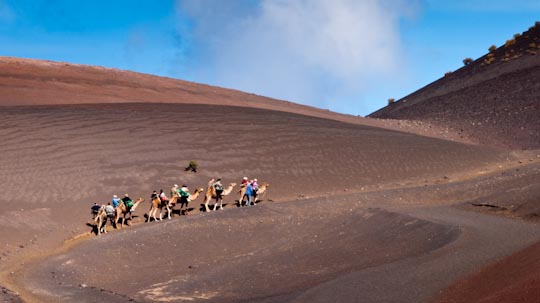
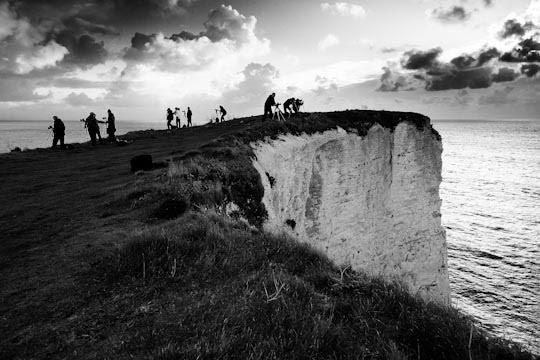
In project nine the aim was to capture several images with figures in them. Figures in the landscape are intended to add balance to the composition, create a focal point, or to establish scale. The images I shot are shown below- the first was taken on the Thames walk at Cliveden Reach, the third and fourth on the slopes of the volcano Tifanmaya in Lanzarote and the final one at Studland in Dorset.
Cliveden Reach, Bucks UK
Timanfaya, Lanzarote
Studland, Dorset UK
In all cases the figures provide a focal point and a sense of scale to the images. I am less convinced that they add to the compositional balance. What came clear to me during this work is that there is a fine line between figures simply adding to the landscape photograph or alternatively taking over the image as the main subject matter. In the second Timanfaya photograph it seems to me that the subject has moved from being a view of the desolate red landscape more to that of a photograph of a camel train set in that landscape. The lesson is to be clear what the image is meant to depict and if it is intended as a landscape to take care that figures merely provide context, scale and a point of interest and do not become the main subject in themselves.
Subscribe to:
Posts (Atom)
Labels
28mm Elmarit
50mm Summicron
accreditation
Alex Soth
American West
Ansel Adams
Art of Snapshot
as
Assignment
Assignment Four
Assignment One
Assignment Two
ball head
Beauty
Berkshire
black and white
Brighton Photo Biennial 2010
british museum
Buckinghamshire
Burnham Beeches
Canada
Caponigro
Central St Martins
Charlie Waite
city
Cliveden
cloud
Club La Santa
collage
competition
composition
course
criticism
Daisy Gilardini
David Alan Harvey
davidnoton
derby
detail
Dorset
drama
dusk
exhibition
f/64
Famara
Fay Godwin
Feedback
Fernando Gomez
figures
Filters
format
framing
Framing foreground interest composition
Freeman
Gabriele Basilico
galen rowell
Georgia O'Keefe
grain
Hambleden
Harrison Hot Springs
hawaii
influence
ironman
Jasper
Joel Meyerowitz
John Davies
Kingston Lacey
Lake District
Landscape
landscape format
Languedoc
Lanzarote
LEARNING LOG-April2010
LEARNING LOG-April2011
LEARNING LOG-August2010
LEARNING LOG-August2011
LEARNING LOG-December2010
LEARNING LOG-Feb2010
LEARNING LOG-February-2011
LEARNING LOG-January-2011
LEARNING LOG-July2010
LEARNING LOG-June2010
LEARNING LOG-June2011
LEARNING LOG-March-2011
LEARNING LOG-March2010
LEARNING LOG-March2011
LEARNING LOG-May2010
LEARNING LOG-May2011
LEARNING LOG-November2010
LEARNING LOG-October 2010
LEARNING LOG-September2010
leica
Lely's Venus
lenses
light
Light Science and Magic
london
LPOY2010
Malhotra
man-made
Marc Garanger
Martin Parr
Mirrors and Windows
Mississippi
Molly Landreth
MOMA
moon
National Media Museum
National Trust
near and far
Nick Gleis
OCA
one acre
opening
Overton Hill
panorama
perspective
Phil Malpas
photographer
polariser
Portfolio
portrait format
portraits
post-modern
projects
Quotation
realism
Rinko Kawauchi
Robert Adams
royalphotographicsociety
Running
seasons
Silhouette
sky
snow
soft colour
soft light
Stephen Gill
street
street 35mm Summicron
Studland
style
Sunrise
Szarkowski
team
telephoto
Terri Weifenbach
test
Timanfaya
trees
triathlon
tripod
TriUK
Tutor
two
UK
Urban Development
USA
water
Watlington Hill
weareoca
West Kennett
Western Art
Weston
wide angle
Windsor
Workshop
Yosemite
About Me
- Keith Greenough LRPS
- I have been taking photographs since I was young boy some 45 years ago, but only seriously since 2005 when I enrolled to study at the Open College of the Arts. I am working towards a BA in Photography. I am a Licentiate of the Royal Photographic Society. This log record details of my projects and assignments during my studies. It also records ideas, work by other artists/photographers, notes on books/websites/exhibitions, influences, discoveries, thoughts, research findings and observations as I work through my courses. You can contact me at keith.greenough@btinternet.com or simply leave a comment on one of my posts.
Landscape Photography Bibliography
- Andrea G Stillman (2007), Ansel Adams 400 Photographs, Little Brown New York USA
- Andy Grundberg (1999), Crisis of the Real, Aperture Foundation New York
- Ansel Adams (2007), Examples The Making of 40 Photographs, Little Brown New York USA
- Ben Maddow(1989), Edward Weston, His Life, Aperture Foundation New York USA
- Charlie Waite (1989), Scottish Islands, Constable London
- Charlie Waite (1992), The Making of Landscape Photographs, Collins and Brown London
- Charlie Waite (1999), Seeing Landscapes, Collins and Brown London
- Charlie Waite (2002), In My Minds Eye, Photographers Institute Press East Sussex UK
- Charlie Waite (2005), Landscape, Collins and Brown London
- Clive Minnitt and Phil Malpas(2009), Finding the Picture, Envisage Books London
- David Noton (2008), PHOTOGRAPY ESSENTIALS: WAITING FOR THE LIGHT, David & Charles PLC, London
- Fay Godwin(1985), Land, William Heinemann London
- Fay Godwin(1990), Our Forbidden Land, Jonathan Cape London
- Fay Godwin(1998), Glassworks & Secret Lives, Stella Press East Sussex UK
- Fay Godwin(2001), Landmarks, Dewi Lewis Publishing Stockport UK
- Galen Rowell (1995), Mountain Light, Sierra Club Books San Francisco USA
- Galen Rowell (2001), Inner Game of Outdoor Photography, Norton & co New York USA
- Galen Rowell (2002),Galen Rowell's Vision: The Art of Adventure Photography, University of California Press USA
- Harry Callaghan (1993), Ansell Adams in Color, Little Brown New York USA
- Hunter, Biver & Fuqua(2007), Light Science & Magic, Elsevier Oxford UK
- James Bentley & Charlie Waite (1987), Languedoc, George Philip London
- Joe Cornish, Charlie Waite, David Ward, Eddie Ephraums (2006), Working the Light, Argentum London
- Joe Cornish, Charlie Waite, David Ward, Eddie Ephraums (2007), Developing Style and Vision, Argentum London
- Joel Meyerowitz (2002), Cape Light, Little Brown and Company New York USA
- John Berger, Ways of Seeing, Penguin Modern Classics
- John P Schaefer (2007),The Ansel Adams Guide Book 2 Basic Techniques of Photography, Little Brown New York USA
- John P Schaefer (2007),The Ansel Adams Guide Book I Basic Techniques of Photography, Little Brown New York USA
- John Szarkowski (1981), American Landscapes, The Museum of Modern Art New York USA
- Landscape Photographer of the Year Collection 01 (2007), AA Publishing
- Landscape Photographer of the Year Collection 02 (2008), AA Publishing
- Landscape Photographer of the Year Collection 03 (2009), AA Publishing
- Liz Wells (1996), Photography:A Critical Introduction, Routledge Oxon
- Liz Wells (2003), The Photography Reader, Routledge Oxon
- Marc Garanger (1989), Louisiane, Kodak
- Robert Adams (1996), Beauty in Photography, Aperture Foundation New York USA
- Robert Adams et al (2009), New Topographics, Steidl Germany
- Stephen Shaw (2004), Uncommon Places The Complete Works, Thames and Hudson, London
- Susan Sontag, On Photography, Penguin Books London
- Terence Pitts (2008), Edward Weston (Icons Series), Taschen
- TPOTY Awards (2010), TRAVEL PHOTOGRAPHER OF THE YEAR Journey Three, Travel Photographer of the Year Suffolk UK
Landscape Photography Links
- Ansel Adams
- Brett Weston
- Brighton Photo Biennial
- Charlie Waite
- Civilian Arts Projects - Terri Weifenbach
- Daisy Gilardini
- David Noton
- Edward Weston
- Ernst Haas
- Fay Godwn
- Format 11
- Franco Fontana - Arps & Co
- Galen Rowell
- Joel Meyerowitz
- Joel Meyerowitz
- John Davies
- John Kippin
- John Pfahl
- Keith Greenough Galleries
- Keith Greenough New Blog
- keith greenough photography
- Landscape Photographer of the Year
- Light and Land
- National Media Museum - Fay Godwin Video
- Open College of the Arts
- Phil Malpas
- Robert Adams
- Royal Photographic Sociey
- Stephen Shore
- The Freeman View
- Two Way Lens - Terri Weifenbach
- Washington Post - Terri Weifenbach